Tuesday, 12 November 2013

ControllingTthe Value Chain – Arla foods

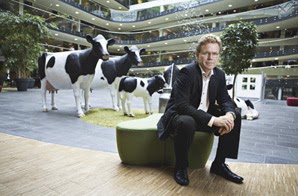
Peder Tuborgh, CEO of Arla foods provides proof that the co-operative model is alive and going global.
 
 
In the wake of the financial crisis and occasionally over-excitable examination of the nature of capitalism, co-operatives have been increasingly talked about. They are the alternative model, but one viewed by most as so alternative as not to be worth exploring.
For those who doubt the robustness and contemporary usefulness of co-ops in a global business world, a visit to the dairy farms of Denmark, Sweden, the UK and Germany might be fruitful. Here they would find that the co-operative cream really does rise to the top. The co-operative model is often used in the dairy industry.
In fact, 70 per cent of the major dairy companies in Europe are co-ops. More than 12,000 dairy farms in Europe are members of the Arla Foods co-operative. Arla is best known for its biggest brands — Lurpak, Arla and Castello. It is a large global business — investing in recent years in Russia, China, the Middle East and Africa — and has been run as a co-operative since its inception in Denmark in the late nineteenth century. It produced 10.4 billion kilograms of milk in 2012, has more than 18,000 employees and its 2012 turnover was some 63,114 billion Danish kroner (£7.2 billion).

Thursday, 31 October 2013

Are you overspending and under-saving, just like the rest of the nation?


“I am only one, but still I am one. I cannot do everything, but still I can do something; and because I cannot do everything, I will not refuse to do something that I can do.” – Helen Keller
 
According to the Bureau of Labor Statistics, on average American household spends 36.9% of their gross annual income on rent/mortgage and utilities!
 
So let’s do the math…
 
If your annual household income is $50,000, you’ll spend $18,450 on rent and utilities and will have $31,550 to cover all of your other remaining expenses.
How about this one: an average American household spends 5.7% of their annual income on restaurants – not counting regular grocery items. That’s $2,850 a year, or $237.50 per month, based on the $50,000 annual income.

Sunday, 29 September 2013

7 Financial Decisions Made in Your 30s That May Haunt You in Your 50s

People often say “life is short” as a justification to do or buy something immediately rather than waiting. But the truth is, life is not short. Life is long. The average life expectancy for an American male is 76.2 years, and 81 years for a female. A thirty-year-old discussing a short life may actually be looking at another 50 long years.
This is good news! And, financially speaking, a long outlook on life is important, because the decisions we make early on have a significant impact on the remainder of our lives. Specifically, these decisions can make or break our retirement plans.

Tuesday, 20 August 2013

3 PRACTICAL IDEAS TO GET YOU ON THE ROAD TO MORE SECURE RETIREMENT DAYS.

1. Become DEBT-FREE, including mortgage.

Eliminate all of your consumer debt, as well as your mortgage. This will make it much easier for you to retire, even if your retirement years aren’t fully funded. Here are few quick “to do’s” to help you ditch your consumer debt:

A. Stop using plastic until you learn responsible use of credit. Anyone using credit cards should aim at paying each monthly balance in full so no interest accrues. There are free cash management tools available to help you do this, following an envelope budgeting system is a great way to help make sure you always have enough cash to pay the bill in full.

Note:

created by Solomon 2009, note videos on this site are not proprietary