Showing posts with label London business school. Show all posts

Wednesday, 8 March 2017

The Man Who Would Be King

It’s virtually impossible to separate emotional reaction from analysis in discussions about Donald Trump. That’s what makes the case so important and interesting. It looks as if this is something quite new and different from the examples of leadership we have been used to in public life. In fact, it has ancient roots and illustrates some key leadership themes.

Sunday, 13 November 2016

5 Tips To find Your Personal Purpose

Invest some time in figuring out your real story and you'll be happier, less stressed and in the right job. By Richard Hytner

What’s your story? Your real story, I mean. Not some carefully curated version of yourself designed to impress friends on Facebook or to look more employable on LinkedIn, useful shortcuts though these social media provide to people wanting to get to know you.

The most authentic and enduring brands are built from the inside out. The least convincing, destined for a short shelf life, are those that believe they can communicate their way to greatness. That’s not branding, it’s spin, and people see that for what it is – manipulative, too good to be true, an over promise that the brand can only ever fail to deliver.

Wednesday, 15 June 2016

Five Reasons Why Leaders Fail

Is the lesson from history that leaders succeed until they fail? You might think fixed-terms presidencies or other forced retirement options help to avoid eventual inevitable failure, allowing leaders such as Nelson Mandela to quit while they’re ahead. His laudable example is an exception; we often face leadership disappointment, even in the most promising people.

This article is provided by the Leadership Institute

Indeed, one might be tempted to wonder if we can just skip the problem altogether and go leaderless. We see this in families, sports clubs, music groups, and even in business. Several companies such as the makers of Gore-Tex have pioneered self-managing teams with fluid sharing of responsibility, and the minimal or episodic involvement of leaders.

Sunday, 14 September 2014

A Better Way To Grow

Now that most major developed countries appear to be returning to a period of growth, the question on the minds of CEOs has shifted from cost reduction and containment to how best to grow. The trouble is that most companies do not have an effective growth strategy. They lack the structure, political capital and resources to be successful.

Growth involves an element of risk taking and adventure that is often at odds with running a successful business. To be successful at growth, companies need to adopt a different paradigm. Instead of looking at ideas for growth on an individual investment go/no-go basis there should be a target of “We will grow X per day by a certain date”. Not only does this credible commitment to growth boost the company’s share price, it provides a target to achieve.

This new paradigm requires that companies get serious about growth and actively manage a programme to achieve the growth they desire. A growth strategy is a practically grounded investment programme and not necessarily a singular idea for examination.

Tuesday, 12 November 2013

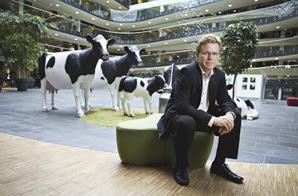
ControllingTthe Value Chain – Arla foods

Peder Tuborgh, CEO of Arla foods provides proof that the co-operative model is alive and going global.
 
 
In the wake of the financial crisis and occasionally over-excitable examination of the nature of capitalism, co-operatives have been increasingly talked about. They are the alternative model, but one viewed by most as so alternative as not to be worth exploring.
For those who doubt the robustness and contemporary usefulness of co-ops in a global business world, a visit to the dairy farms of Denmark, Sweden, the UK and Germany might be fruitful. Here they would find that the co-operative cream really does rise to the top. The co-operative model is often used in the dairy industry.
In fact, 70 per cent of the major dairy companies in Europe are co-ops. More than 12,000 dairy farms in Europe are members of the Arla Foods co-operative. Arla is best known for its biggest brands — Lurpak, Arla and Castello. It is a large global business — investing in recent years in Russia, China, the Middle East and Africa — and has been run as a co-operative since its inception in Denmark in the late nineteenth century. It produced 10.4 billion kilograms of milk in 2012, has more than 18,000 employees and its 2012 turnover was some 63,114 billion Danish kroner (£7.2 billion).

Saturday, 11 May 2013

Rethinking The Responsibility Of Business Leaders

What is the primary responsibility of business leaders today? Is it to make a financial return for their shareholders? Or is it to contribute more broadly to the welfare of employees and society as a whole?


This question has always been important, but it takes on greater significance as we seek to recover from the worst contraction since the Great Depression. How business leaders respond, and how they prioritise different stakeholders, will have a major impact on the speed of recovery.

Monday, 14 May 2012

How London really won the games

How London really won the gamesWeb Exclusive: The 2012 Olympic Games were never supposed to be in London. Michael Payne provides the inside story on how the bid was won


London entered the race to host the 2012 Olympic Games back in 2003. It was an outsider and stumbled through the early bid process. London trailed behind the favourite Paris, with Madrid, New York and Moscow all running hard.  London even struggled to find a CEO willing to take on the daunting task of leading the bid.  Perhaps surprisingly, no UK executive saw it as a particularly enticing career move, and eventually the American business woman, Barbara Cassani was persuaded to step forward. By the time the International Olympic Committee (IOC) had completed its initial evaluation of the technical files, London was ranked a distant third in the race and, by some, in an increasingly lacklustre fourth place.

Family affairs

Web Exclusive: Many believe that — when it comes to businesses started and operated by a family — the older the company, the more likely it is that that company will go public or be taken over by another firm. Julian Franks and Paolo Volpin found that the location of a family business is a major factor in who owns and operates it in the long term.

Family affairsAnyone starting a family business has dreams of prosperity, success and a bountiful future. If a person’s business dreams involve generations of family members owning and running the company —all dedicated to preserving the legacy and controlling the business — France, Germany or Italy would be ideal starting grounds for such an endeavour. If the dreams involve building the company and then selling it off to the highest bidder so the family can retire in comfort, the United Kingdom would be the better place to set up shop.

Wednesday, 14 March 2012

Game changing

Web Exclusive: What is the art of great sports broadcasting? In conversation with Des Dearlove, Barney Francis, Managing Director of Sky Sports, zooms in

Comments

Barney Francis is managing director of Sky Sports. In a television career spanning 18 years, he has worked in the multi-channel, terrestrial and independent sectors. At Sky, he was executive producer for cricket, leading his team through two ICC World Cups, two Ashes Tours, England tours to nine nations, and the first Twenty20 Cup. In 2007, he became executive producer for Sky’s Premier League football and in 2008 executive producer for the EUFA Champions League. As managing director, Francis has continued to enhance the Sky

Sports roster of sporting legends, adding the Masters from Augusta and Formula 1 to its rights portfolio as well as overseeing the introduction of 3D — broadcasting the world’s first live 3D sports event in 2010.

DES DEARLOVE The excitement of live sport is that you never know what’s going to happen next. But that must be a nightmare for a manager. What’s it like making decisions in real time — with millions of viewers watching?

BARNEY FRANCIS It means that very often your decision-making process has to be based on pure instinct. When you are producing or directing television programmes, you have to make a decision now. Not in five seconds time, because the viewer at home is thinking what on earth is going on?

So I think very quickly you’re able to understand right from wrong, you’re also able to decide, if you are taking a programme in this direction, whether it be a football match or a cricket match, if that’s wrong, very quickly you need to jump from path A to path B without the viewer at home noticing. So it’s a good grounding for management, in many ways. You go into any live broadcast thinking this is what we plan to do today, but things could change. Who knows? The floodlights could go off in a football match.

Monday, 30 January 2012

The Davos Agenda

From 25 January the hotels, meeting rooms, bars, restaurants, and most remaining nooks and crannies in the small Swiss town of Davos will be filled with leaders of all descriptions from around the world joining the great annual debate on the state of the world otherwise known as the World Economic Forum’s Annual Meeting.

The theme for the 2012 meeting is “The Great Transformation: Shaping New Models”.  “The necessary conceptual models do not exist from which to develop a systemic understanding of the great transformations taking place now and in the future,” says the WEF’s Klaus Schwab. “It is hubris to frame this transition as a global management problem of integrating people, systems and technologies.  It is an indisputable leadership challenge that ultimately requires new models, bold ideas and personal courage to ensure that this century improves the human condition rather than capping its potential.”

Taking part in the debates during Davos will be London Business School’s Sir Andrew Likierman, Costas Markides and Francesca Cornelli and Lynda Gratton.  They will be rubbing shoulders with the usual array of celebrities, politicians, artists and scientists.  Those speaking include Murray Gell-Mann the Nobel laureate physicist; the deep sea diver Sylvia Earle; champion of emotional intelligence, Daniel Goleman; Tom Friedman, author of The World is Flat; Harvard’s Michael Porter and many more.

An alternative agenda


But what should be on the agenda as the greatest minds and the most influential leaders sit down to debate?  “If I had to pick one topic, it would be growth,” says London Business School professor Rajesh Chandy. “The particular questions around growth would be different for developed and developing countries, however. For developed countries, the question is: How can we create substantial growth again? For developing countries, the question is: How can we create growth in a way that benefits as many of our people as possible?”

Note:

created by Solomon 2009, note videos on this site are not proprietary